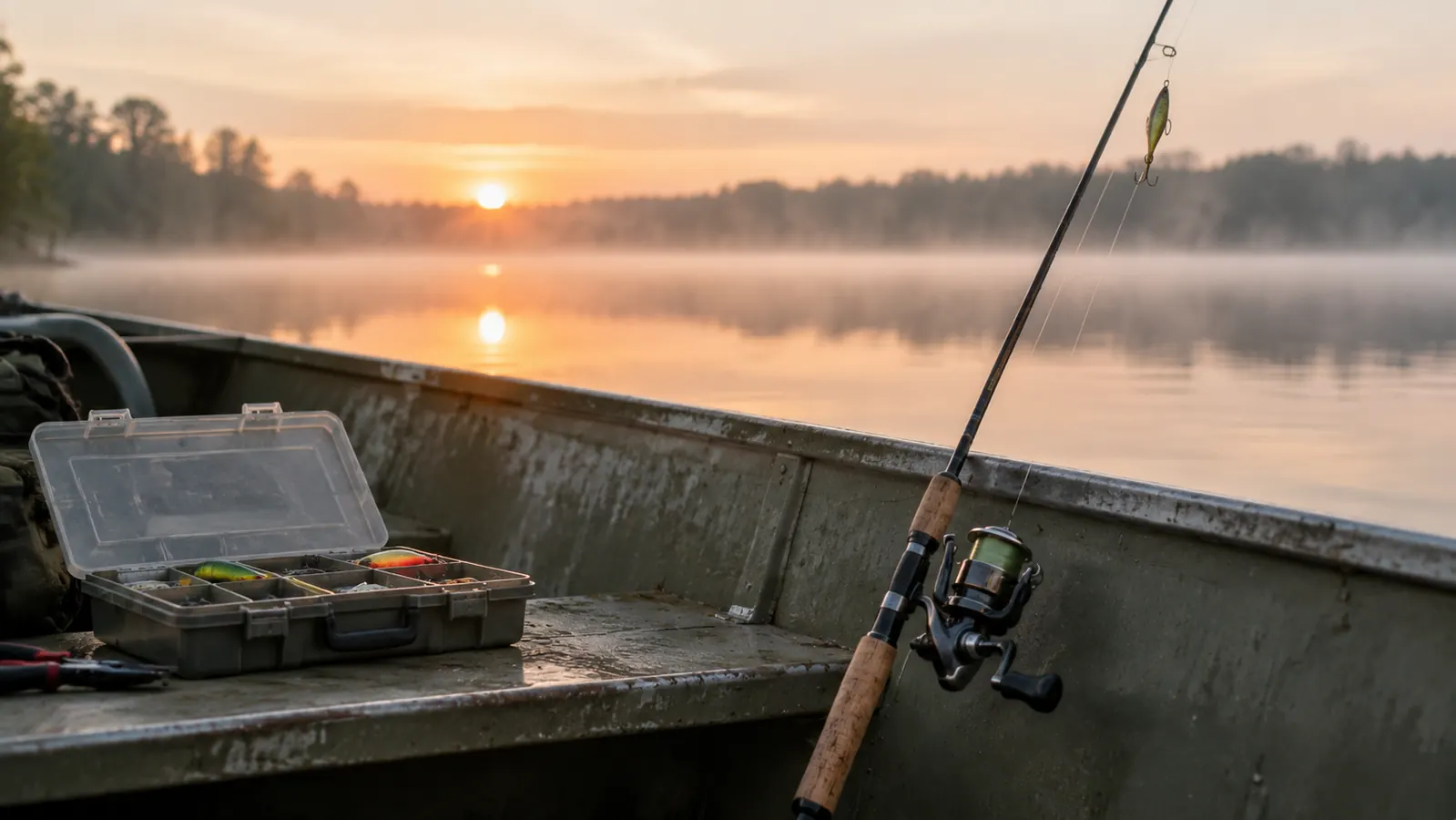
Last spring I bought the Ugly Stik 5-foot complete spinning kit for one reason: I wanted a rod in the boat that was not mine. Something a buddy could grab when he climbed in without gear. Something that could ride behind the truck seat for three weeks and still work when I pulled it out. Seven months later it has caught more crappie than the rod I actually meant to fish with that spring, and it is the rod I reach for on most jig mornings. That surprises me. What does not surprise me, after a few decades of buying cheap combos, is how many people buy a kit like this expecting something it was never built to do, then blame the rod. So here is the version of this review I would give you at the ramp, including the parts that are not flattering.
The context matters, so here it is. I am 58, retired out of HVAC work, and I live about fifteen minutes from Lake Norman in North Carolina with my wife, Denise. I fish two or three mornings a week and most Saturdays, out of a 16-foot aluminum jon boat I launch at a public ramp, or off the bank, or off a friend's dock. My targets are crappie, panfish, some largemouth, and catfish on the Catawba below the dam with heavier gear. If you fish differently than that, the rest of this will tell you pretty quickly whether the kit fits you.
The Quick Verdict
A short, light, honest combo that earns its place as a spare, a boat rod, or a guest rig. Buy it for crappie, panfish, and tight water. Do not buy it to drag bass out of weeds.
Amazon Check Today's Price →The spare rod that turned into the first one I pick up
Five feet, two pieces, light power, 16 ounces in the hand. If your fishing is small jigs and short casts along a bank, this is the combo that does it without asking for much.
Amazon Check Today's Price on Amazon →How This Kit Ended Up in My Boat
I bought it as a spare, and that is the honest origin story. I already had a 7-foot medium spinning rod with a KastKing Sharky 3000 on it for catfish below the Catawba dam, and a 7-foot medium-heavy casting rod with a Piscifun Torrent for bass on Lake Norman. What I did not have was a short, light rod that could live in the boat without me worrying about it. The Ugly Stik kit filled that slot, and it filled it for less fuss than I expected.
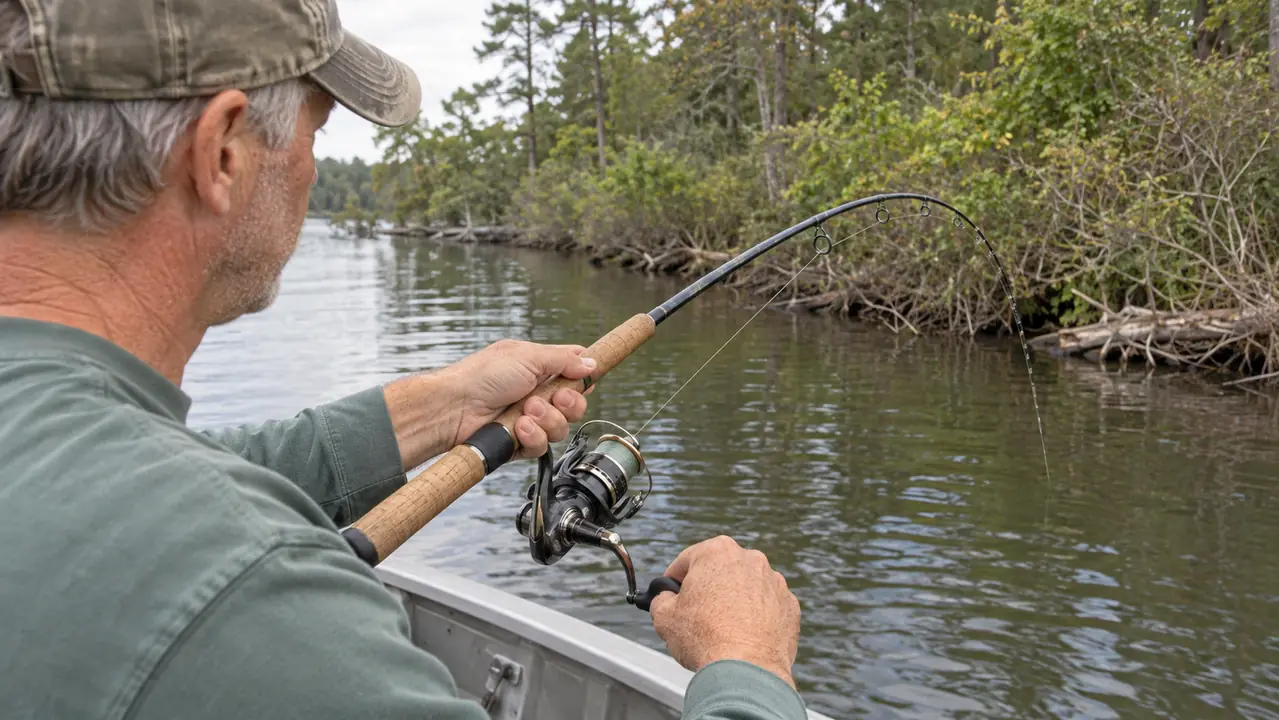
The first morning I fished it, I was working the back of a creek arm where the bank comes up fast and the trees hang low over the water. A 7-foot rod is a liability in there. You either cast sidearm under the branches or you spend the morning getting lures back out of wood. The 5-foot rod let me drop a small jig straight down along the bank and lift it back without touching a branch. Twelve crappie that morning, most of them on the drop, and I never made a cast longer than twenty feet.
Since then it goes out probably two mornings in three. It is the rod I hand to a friend who shows up at the ramp without gear. It is also the rod I reach for when I want to feel a light jig tick through a brush pile, which is a thing I did not expect when I bought a spare. Most spare rods stay spares. This one climbed out of the boat and got used.
What Nobody Tells You About a 5-Foot Light Rod
Five feet is short. You can read that off the listing. What the listing will not tell you is what short actually costs you, and it costs you three things.
Distance, first. A 5-foot light rod with 6-pound mono and a small jig is a close-quarters tool. I can put a 1/16-ounce jig out there maybe 30 to 40 feet with decent accuracy. On my 7-foot medium rod I can push the same jig half again as far. Sitting over a brush pile 20 feet off the bow on a calm morning, that gap does not matter at all. Standing on a bank where the fish are holding 50 feet out, it matters a lot.
Leverage, second. Light power plus a short blank means small fish feel bigger and big fish feel like a problem. A 2-pound crappie is a good time on this rod. A 4-pound largemouth that eats your crappie jig is going to make you work, and if it turns for a laydown you are probably going to lose it. I have lost two that way. I do not blame the rod. I was fishing 6-pound line next to cover, and that is on me.
Wind, third, and this is the one I did not see coming. A short rod with light line is less forgiving in a breeze than a long rod. The cast is quicker, the loop is smaller, and a gust at the wrong moment drops your jig six feet in front of the boat. I quit fishing it on breezy afternoons. Not because it fails, but because it stops being pleasant. If you fish open water on windy days, a short light rod will wear on you by lunch.
The Reel: Read the Numbers Before You Spool It
The reel in the kit is a basic spinning reel with a 5.2:1 gear ratio, rated for 10-pound line, with capacity for 240 yards of 6-pound monofilament. The handle works in either hand, so a left-handed guest is not stuck casting it sideways. Rod and reel together weigh 16 ounces, which is the number that matters most when you are holding it up all morning.
5.2:1 is a slow, steady retrieve. If you are used to burning a bait back to the boat, this reel will feel like it is thinking about it. For crappie jigs, small crankbaits, and a bobber rig, that ratio is right where I want it. I reel slow anyway, and in a reel this size I would rather have a little turning force than a lot of speed.
The capacity number is the one people misread. 240/6 does not mean the reel only takes 6-pound line, but it does tell you what the reel was designed around. I spooled mine with 6-pound mono and it behaves. I tried 10-pound on a spare spool and got more loops and stiffer line coming off the spool. I went back to 6 and stayed there.
The drag is workable, not smooth. It does what it needs to on panfish. If something with shoulders takes line, it gives line in a slightly grainy way. Mine has not failed. It has felt inexpensive, and those are different things. I would rather tell you that than pretend a kit reel pulls like a machined one.
Maintenance is the same as any reel. I rinse it with fresh water after every trip and put a drop of reel oil on it once a month, along with the rest of my reels. Seven months in it still turns freely. Whether it turns in three years, I cannot tell you, and anybody who says they know is guessing.
Seven Months of Honest Wear
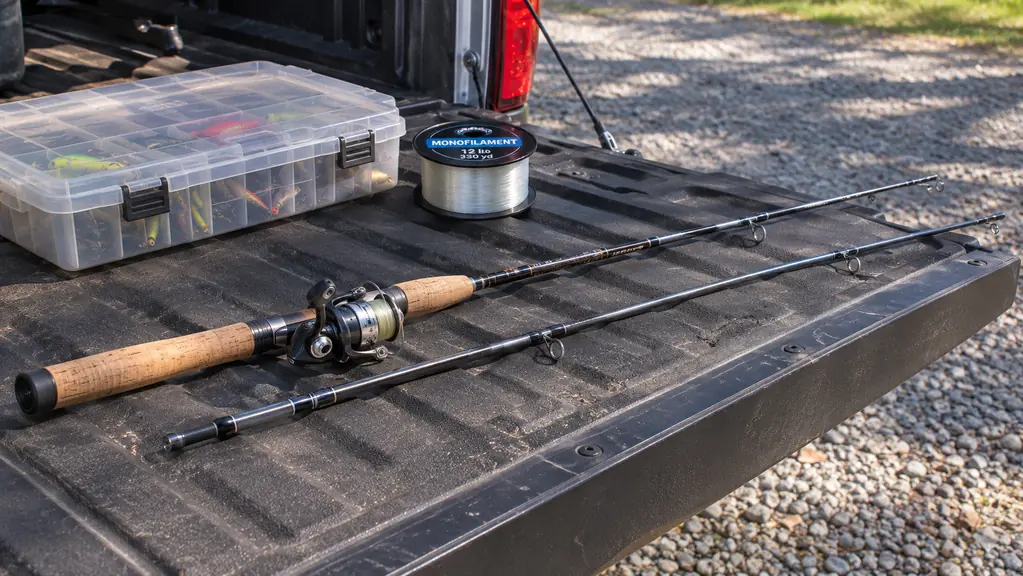
I have not been careful with it. It rides in the boat, sometimes in the truck bed under a towel, once in the back seat next to a tackle box that slides every time I take a turn too fast. Nothing has been broken off it and nothing has been babied either.
The two-piece joint is the spot to watch. Mine has stayed snug, but a two-piece rod always needs checking. I twist it together firmly, and I check it again after a couple of hours on the water. If it works loose mid-cast you will feel the top section shift and it will cost you a lure. That is a two-piece rod issue, not an Ugly Stik issue, and it is worth knowing before your first trip.
The guides have stayed clean and the finish has held. The grip has taken on the grime any grip takes on after a season of jigs and bait. Nothing has come loose. Nothing has rusted, and this rod has been rained on twice and put away damp once, which is one more time than I would recommend to anybody.
The one failure I have had was not the rod's fault. I set the hook on something heavy in a laydown, 6-pound line, drag still tight from the last fish, and the line popped above the knot. The rod did exactly what a light rod does. It bent, it held, and the line gave. I mention it because it is useful: this kit will not cover for heavy line and a locked drag. Set the drag light, let a good fish run if it wants to run, and land it when it slows down.
The line it comes spooled with is the weakest part of the package. That is true of nearly every combo that arrives ready to fish, so it is not a knock on this kit specifically. I respooled mine after the second trip with 6-pound mono I trust, and the difference in casting was immediate. Do that before your first trip and you skip a frustrating month.
What I Liked
- Short enough to cast under branches and along a tight bank
- Light power makes a 10-inch crappie feel worth the trip
- Two pieces break down and store behind a truck seat or in a rod locker
- 16 ounces all in, so you can hold it all morning without thinking about it
- Handle works in either hand, so a left-handed guest can fish it
- 5.2:1 retrieve and 6-pound mono capacity suit jigs and panfish
Where It Falls Short
- Cannot cast far, and will not pull a bass out of cover
- Pre-spooled line is worth replacing on day one
- Drag works but feels grainy under load
- Light power is a real limit, not a suggestion
- A breeze makes the short cast frustrating fast
I bought this kit so a guest would have something to fish with. Seven months later it is the rod I reach for when I want to feel a crappie tap on a small jig.
What I Compared It To, and Why It Still Has a Job
My grandson Tyler, who is ten, fishes a Zebco 33 spincast combo. He was tangling my spinning reels every Saturday, so a push-button was the right call for him. That rod is his and it does its job. The Ugly Stik kit does not compete with it. One is a kid's push-button for bluegill at the neighborhood pond, the other is a small light spinning rod an adult can fish with intent.
I also picked up a PLUSINNO telescopic combo this fall to keep behind the truck seat. Collapsed into its case it disappears into a travel bag, which is the entire point of it. It is not as crisp as the Ugly Stik, and I have had it two months, so I am not going to claim I know how it holds up. The Ugly Stik is the better fishing rod. The telescopic is the better thing to have in a rental car.
My heavier gear is a completely separate conversation. The Sharky 3000 on a 7-foot medium rod handles catfish below the dam, and the Torrent on a 7-foot medium-heavy handles bass with plastics and spinnerbaits. If you already own a rod like that, this kit is not a replacement for it. It is the second rod, the one that lives where you fish instead of where you store things.
Who This Is For
Bank fishermen and pond walkers. A 5-foot light rod is easier to carry down a trail and easier to cast under overhanging trees than a 7-footer, and the difference shows up by the second stop.
Boat and kayak anglers who want a spare that takes up almost no room. Two pieces means it breaks down and goes in a locker, a rod box, or behind a seat, and it comes back out ready to fish.
Anyone who brings guests. Hand it to a friend who has not fished since he was a kid and he will be casting in five minutes. The handle works in either hand, so nobody gets left out of the rotation.
Crappie and panfish fishermen throwing small jigs and bait on 6-pound line. That is the exact job this kit was built for, and the gear ratio and line rating line up with it instead of fighting it.
Parents and grandparents buying a first real rod for a kid who has outgrown the push-button. It is light enough for a ten-year-old to hold and short enough that they will not knock it on every branch between the truck and the water.
Who Should Skip It
Bass fishermen working grass, wood, and docks with anything heavier than a finesse bait. Light power and 6-pound line in cover is a donation to the lake, and you will figure that out the hard way.
Anyone whose fishing depends on distance. If you need to reach a point 60 feet out, this rod will frustrate you by the second trip. Buy a 7-footer and thank yourself later.
Catfish anglers. I fish the Catawba below the dam with a 3000-size reel on a medium rod for a reason. This kit is not that, and it will not become that with a heavier line on it.
Anyone who wants one rod to do everything. It does a narrow set of jobs well. It is not a do-everything combo, and if that is what you are shopping for, keep looking.
Anyone who will not respool it. The factory line is the first thing I would change. If you plan to fish it as it comes for a year and then blame the rod, skip it and save us both the conversation at the ramp.
Small water, short casts, light jigs. That is the job this kit does.
Five feet, two pieces, light power, and a 5.2:1 reel built around 6-pound mono. Spool it with line you trust before the first trip and it will earn its spot in the boat.
Amazon Check Today's Price on Amazon →