
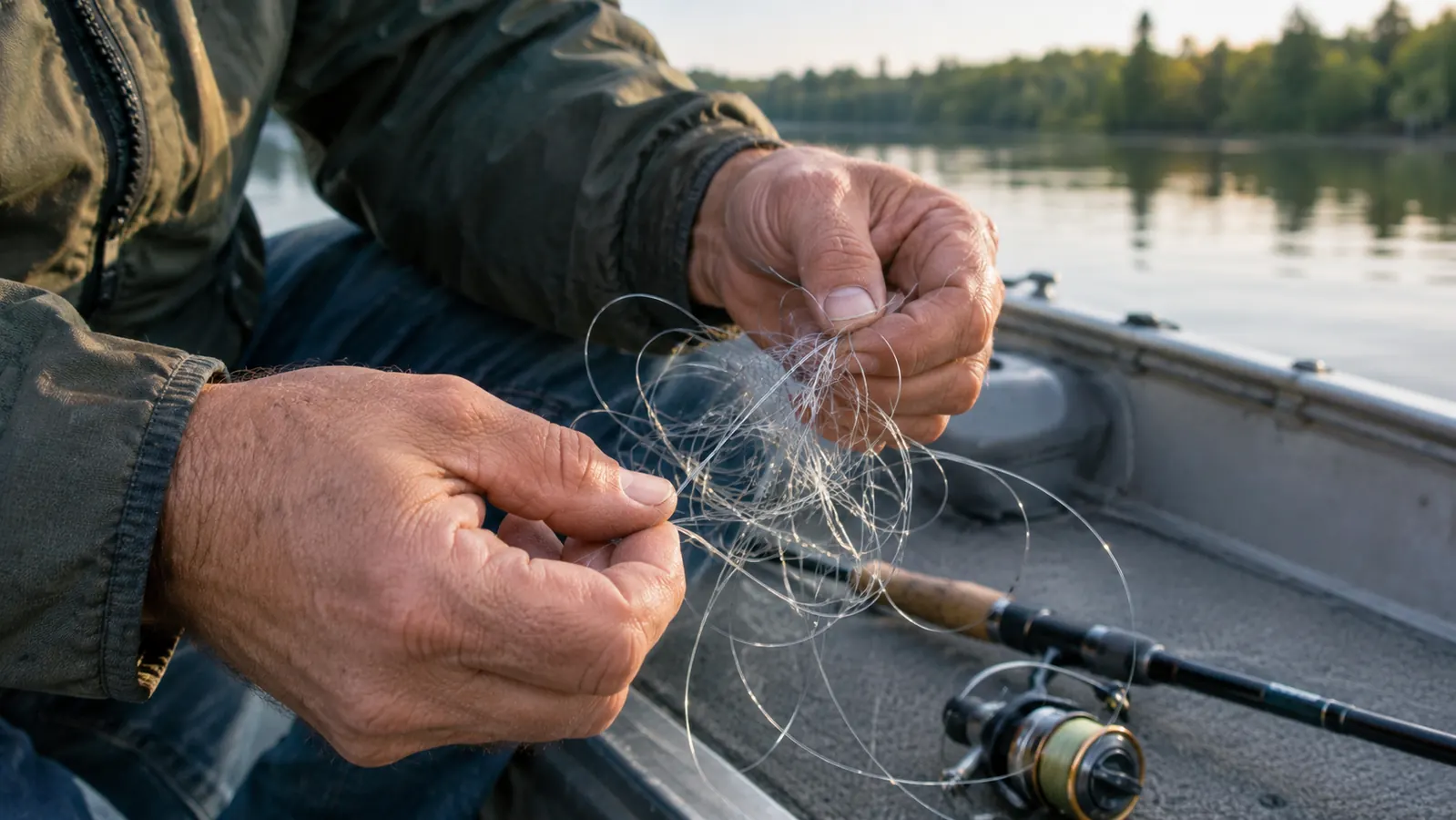
Six weeks after I spooled my first baitcaster, I stood in the garage at ten at night with a headlamp on, picking a bird's nest out of forty yards of line while Denise asked through the door whether I had died. I had not. I had done what most spinning reel fishermen do when they switch over. I blamed the reel, said a few things I would not repeat in church, and cut the line off with a pair of nippers. That reel was a Piscifun Torrent, right-hand retrieve, 7.1:1, and it was the third baitcaster I had owned. The first two I gave away. This one stayed on the rod, and the reason it stayed is the reason for this page. The reel was never the problem.
Backlash happens when the spool keeps turning after the lure has slowed down. The line has to go somewhere, so it goes into a pile. Every baitcaster on earth does it, from a bargain reel to one that costs more than my jon boat, and no brake system on the market removes the need for your thumb. What a brake does is widen the margin for the mistakes you are going to make anyway. Learning to work inside that margin is the whole skill. It takes about five trips, not five years.
The reel that made me learn instead of quit
I run the Piscifun Torrent on a 7-foot medium-heavy casting rod for bass on Lake Norman. Right-hand retrieve, 7.1:1, magnetic brake, 18 pounds of drag, 8 ounces on the scale. It carries a 3-year manufacturer warranty, which is more than I can say for the two I gave away.
Amazon Check Today's Price on Amazon →Why a Baitcaster Backlashes and a Spinning Reel Does Not
On a spinning reel the line falls off a fixed spool and the rotor handles the rest. Nothing is spinning free under your thumb. On a baitcaster the spool is the whole mechanism. One turn of the handle on my Torrent picks up 30 inches of line, which is what a 7.1:1 ratio buys you on the retrieve. On the cast, that same spool turns with nothing geared to it at all. A lure pulling line off at speed does not slow down in a straight line. It slows down the way a truck slows when the driver lifts off the gas. Early, gradually, and the spool does not get the message.
Which is why the fix is not a better reel, or a more expensive one, or one with more magnets in it. The fix is your thumb, your brake setting, and the weight of what you are throwing. Get those three lined up and backlash goes from a weekly event to a thing that happens when you get careless in the wind. I still get one. I got one two weeks ago off a dock on the Catawba, and it was my fault, and I knew it before the lure landed.
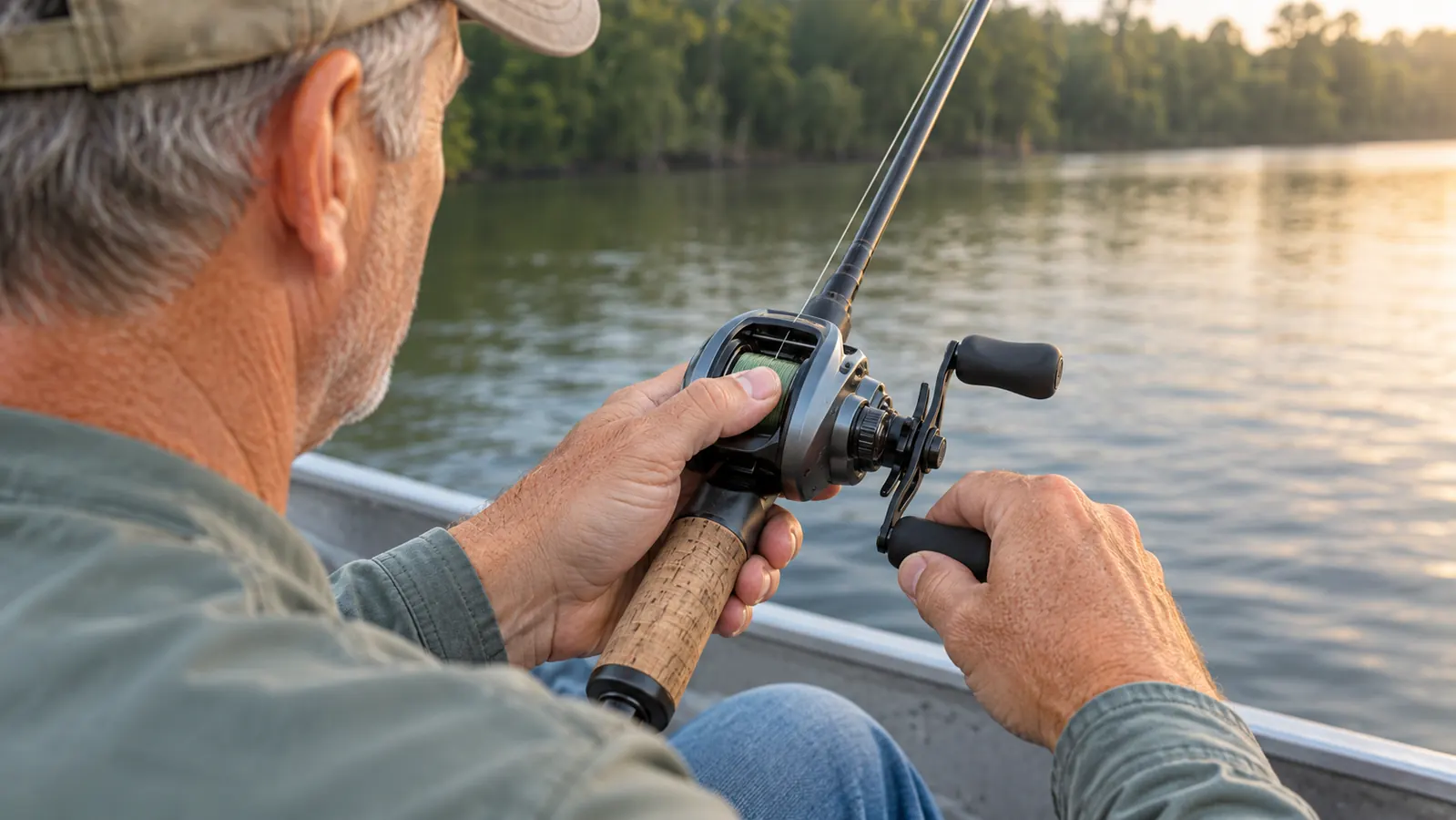
The Five Steps That Cut My Backlash Down to Almost Nothing
I am not going to dress this up as a system. It is five habits, and I picked them up one trip at a time because each one cost me a bird's nest bad enough to remember.
Step 1: Spool It Tight, and Stop a Little Short of Full
A loose spool is the quiet cause of half the backlash I see at the ramp. If the line going on is not under tension, the bottom of the spool is soft. On the cast, that soft line grabs the layer above it and the whole stack collapses. Pinch the line between your thumb and forefinger with some drag on it, or run it through a folded newspaper with the pages closed on it, and wind it on firm. Not so hard you bury it, but firm and even from one edge to the other.
My Torrent holds 120 yards of 10-pound mono or 120 yards of 30-pound braid, and I fill mine to about an eighth of an inch below the lip. Overfilled is worse than underfilled when you are learning. Extra line at the lip rubs the frame on the way out, the cast loses speed, and the spool overruns while the lure is still trying to leave. Start low. You can always add line. You cannot unspool a bird's nest at dusk with the fish starting to come up.
One more thing about mono. If your line has been sitting on that spool since last spring, it has taken a set, and every coil is a little hook waiting to grab the line underneath it. Strip the top thirty yards or respool. Line is the cheapest thing on the boat and the only thing standing between you and the fish.
Step 2: Start With the Magnetic Brake Heavy, Then Back It Off
The Torrent's brake is magnetic, and a magnetic brake drags on the spool harder as the spool spins faster. Set it at the high end for your first few outings. The cast will feel short and dull and a little bit insulting. That is fine. You are not out there to be impressed. You are out there to feel what a clean cast is like, so that you know the moment you have lost it.
Then back it off, a little at a time and not all at once. I backed mine down one trip at a time until the short casts stopped feeling short. If you take too much off, you will know within three casts, and you can put it back. What you are looking for is the setting where a normal cast with your normal lure goes out clean and lands with the spool already stopped. Five months in, mine sits well below where it started.
The rule I use is simple. If I backlash twice in a session, the brake goes back up. Not as punishment. It goes up because I am tired, my thumb is lazy, and the brake is the only part of the outfit still paying attention. Any time the wind picks up or I tie on something light, it goes back up too, and I stop feeling bad about it.
Step 3: Load the Rod Before You Let Go of the Spool
A baitcaster is not a spinning rod and you cannot flick it. The rod has to load, and that load is what pulls the line off the spool. If you snap at it with your wrist and the rod never bends, the lure leaves slow, the spool has already started turning, and the line has nowhere to go. That is the backlash that happens on the front end of the cast, and it is the one that makes people say the reel is junk.
Bring the rod back to about two o'clock and let the lure swing back and pull the tip into a bend. Then come forward smooth and let the rod do the work, with your hand mostly stopping it at the end. With my 7-foot medium-heavy rod and a three-eighths ounce Texas rig, I can feel the load in the top third of the rod before I ever move forward. If I cannot feel it, I am either throwing too light or I am rushing.
This is also why a baitcaster is worth the trouble on a windy day. A loaded rod casts flat and low and punches under the wind. A spinning reel flicks the lure up into it and the wind does whatever it wants with it. That difference is the whole reason I keep at it.
Step 4: Stop the Spool Before the Lure Lands
The last third of the cast is where most of the bad ones are born. The lure is slowing down and the spool is not. Lay your thumb on the spool lightly as the lure comes down and feather it, then stop it dead a foot above the water. The lure should drop that last foot with the spool already stopped. If you are waiting for the splash to put your thumb down, you are already late and you already know it.
I spent a Sunday afternoon in the backyard with a practice plug and a coffee can as a target, and I did not catch a thing, and it was the best two hours I put into fishing that month. Twenty casts, then pick out the nest, then twenty more. By the end of it I could feel the spool starting to run before I could see it. That is the whole skill, and it does not come from reading.
Keep your thumb resting on the spool in the air even on a good cast. Resting, not pressing. It costs you nothing and it buys you a tenth of a second, and a tenth of a second is the difference between a clean cast and ten minutes on your knees.
Step 5: Match the Lure to the Reel, and Reset When You Change
Every baitcaster has a weight it likes. Mine likes three-eighths to half an ounce. A weightless soft plastic on a baitcaster is a lesson in humility. A quarter-ounce lure into a headwind on Lake Norman is the same lesson with more wind and a longer walk back to the ramp. If you have to throw light, turn the brake up and accept a shorter cast. There is no setting that makes a light lure behave like a heavy one.
When you tie on something different, recheck everything. Go from a spinnerbait to a light Texas rig and the brake setting that was perfect a minute ago is now too loose. The Piscifun weighs 8 ounces, light enough that my rod does not feel nose heavy at the end of a morning, but the reel has no idea what you tied on. That part is on you, every time.
The rod matters in this too. A medium-heavy casting rod rated for the weight you are throwing and a reel set to match it will cut your backlash in half before you change a single thing about your cast. Put the same reel on a rod that is too stiff for the lure and you will fight it all morning.
Five months in, I can throw a three-eighths ounce Texas rig into a headwind on Lake Norman and not touch the line again until I change lures. Getting there cost me about five trips and one bad Sunday in the garage.
What Else Helps
Wind is the amplifier. Casting straight into it, the lure slows down fast and the spool does not, and the nest is deeper and tighter than the ones you get in still air. When the wind is up on the main lake, I fish downwind and let the boat drift, or I move into the creeks where there is a bank to break it. There is no shame in it. There is shame in spending a nice morning on your knees.
Braid is more forgiving than mono for a beginner, because it does not hold a set and it does not coil off the spool. What it will do is dig into itself if you spool it loose, and a backlash in braid is a tighter, meaner knot than a backlash in mono. Whatever you put on, check the last ten feet after every bad one and cut back to clean line. A weak spot you cannot see is how you lose the fish of the morning.
Rinse the reel with fresh water after every trip and put a drop of reel oil on it once a month, same as the rest of them. A gritty spool does not spin consistently, and an inconsistent spool is harder to learn on. Mine hangs on a wall rack in the garage next to everything else and gets the same treatment, and it has been fine.
And if you only get out three or four times a year, a spinning reel is still the right tool and there is nothing wrong with saying so. I keep a spinning outfit in the boat for exactly that reason. Baitcasting rewards repetition. If you are not going to put in the trips, spend your money on line and gas instead.
Five trips of practice beats five reels in a drawer
The Piscifun Torrent is the one that stayed on my rod. Right-hand retrieve, 7.1:1, magnetic brake, 18 pounds of drag, 120 yards of 10-pound mono or 30-pound braid, 3-year manufacturer warranty. Set the brake high, load the rod, and keep your thumb over the spool.
Amazon Check Today's Price on Amazon →