
The drag on my old catfish reel quit on a cold Tuesday in late February, below the dam, with a fish on that was heavier than anything I had a right to expect. I landed it. I did not land the reel. That one went in the barrel at the ramp, and by the end of the week there was a KastKing Sharky, size 3000, sitting on my workbench waiting to go on a rod. I have fished it for about nine months now, on the Catawba River for catfish and on Lake Norman for bass and crappie, and I have an opinion worth passing along.
Here is the short version for anybody at the ramp who does not want to stand there listening to me. It stayed on the rod. Nine months, fresh water only, two or three mornings a week plus most Saturdays, and I have never had a reason to take it off and put something else in its place. That is the whole review. The rest of this is the detail behind it.
The Quick Verdict
Nine months on the Catawba and Lake Norman. The drag never slipped and the gearing still turns tight. It is not a light reel and it is not a fast reel, but it has not given me a reason to swap it out.
Amazon Check Today's Price →Nine months in, it is still the reel on my catfish rod
Size 3000, 6.2:1 gear ratio, 33 pound maximum drag, 10+1 stainless steel bearings, aluminum handle. Check today's price and availability on Amazon before your next trip.
Amazon Check Today's Price on Amazon →How I've Used It
I bought it late last winter and put it straight onto a 7-foot medium spinning rod I already owned, the one that lives in the boat most of the year. The first trip out was the Catawba below the dam, cut bait on the bottom, water cold enough that I wore two pairs of socks and still felt it. Nothing about that morning was gentle on equipment. The reel rode in the bottom of the aluminum boat, got laid down in the gravel at the ramp, and got rinsed in the driveway when I got home, which is what I do with every reel I own.
Since then it has been on that rod through spring, summer, and now into fall. Lake Norman for largemouth along the riprap and out on the points. Crappie on the brush piles when I can find them, which is less often than I would like. Back to the river whenever the flow below the dam is right for catfish. I fish two or three mornings a week since I retired, plus most Saturdays, so this is not a reel that has made a handful of casts in the driveway and gone back in the box.
One morning in early April stands out. Air temperature was forty-one when I launched at the public ramp, wind out of the north at maybe ten, and the water was still cold enough that the bass had not moved up. I fished the riprap on the west side for three hours and caught two short fish. What I remember is a couple hundred casts with a quarter-ounce jig and no loop, no hitch, no wind knot. That kind of morning tells you more about a reel than a good day does.
My grandson Tyler is ten and fishes with me some Saturdays. He has borrowed this rod more than once, either because his own push-button rod was tangled or because he wanted to throw something the little rod would not handle. He has not broken it, which for a ten-year-old is a real endorsement. Fresh water rinse after every trip, a drop of reel oil once a month. That is the only maintenance it has had.
What the 6.2:1 Gear Ratio Actually Does
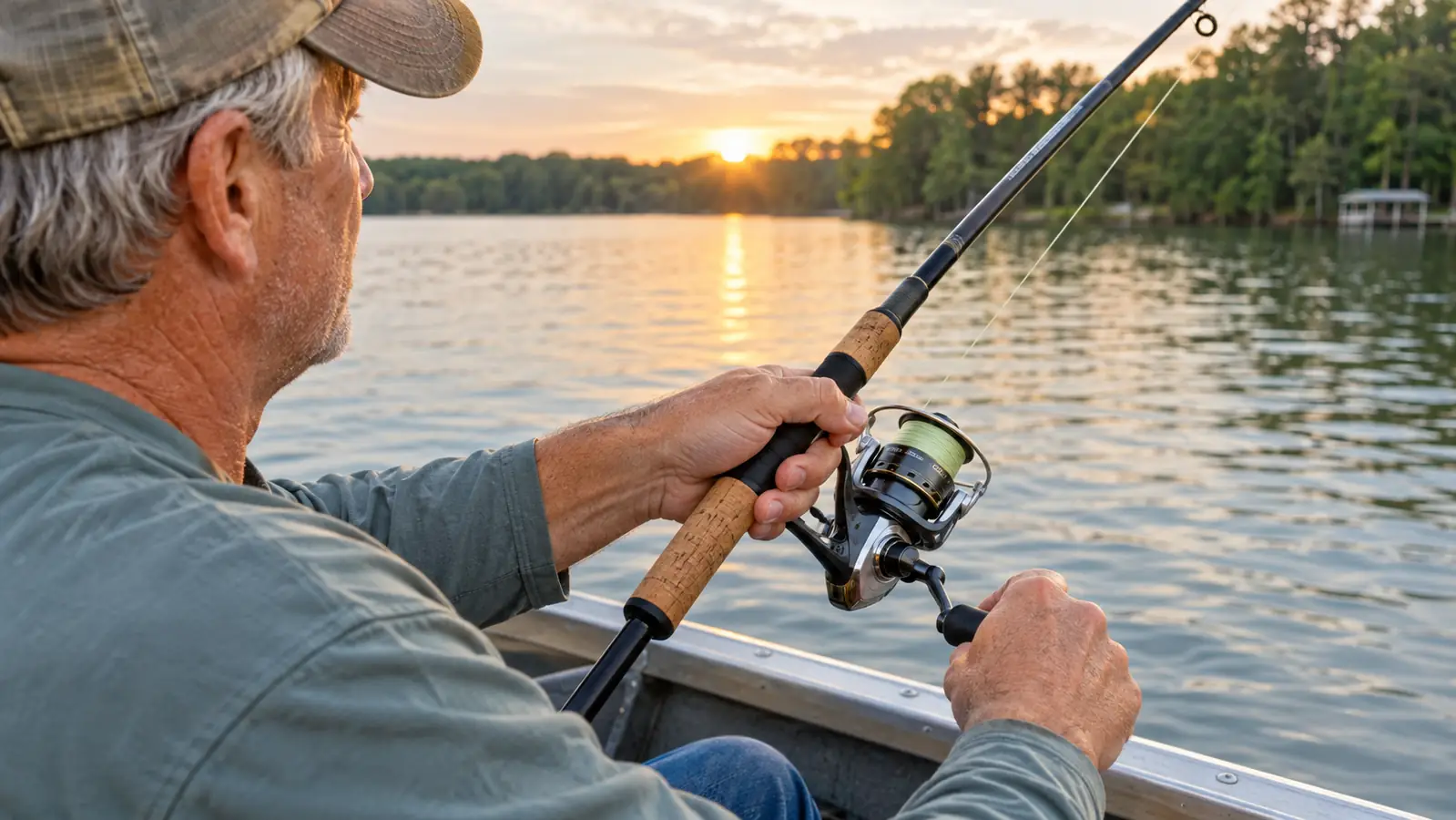
Six point two to one means the spool turns about six times for every turn of the handle. On a spinning reel that is a middle-of-the-road retrieve, not a burner and not a cranker. For what I do, which is a lot of jig fishing and a lot of bait sitting on the bottom, it is the right middle. It picks up slack fast enough that I am not standing there winding and winding while a crappie jig drifts somewhere I did not intend.
Below the dam the gearing barely matters. The rod sits in a holder, the bait sits on the bottom, and I am watching the rod tip and drinking coffee. Where it mattered was Lake Norman, working a small swimbait and a shaky head along the riprap on the west side. Dragging a bait over rock wants a retrieve you can control, and 6.2:1 does that without me having to think about it. If I want to burn a lipless crankbait across a point, I use a baitcaster. Different tool for a different job.
Here is the arithmetic I did on the water one morning, because I am the sort of person who does arithmetic on the water. Twenty turns of the handle picks up about the amount of line I want when I am working a jig down a ledge in twelve feet of water. On a faster reel those same twenty turns pull the jig out of the strike zone before I am ready. I am not saying one is right. I am saying the middle retrieve lets me stay in contact.
One more thing about the ratio that took me a couple of trips to appreciate. When a fish runs at the boat and you need to catch up, a faster reel helps. When a big catfish makes a short run and you need to gain line without horsing it, a slower reel helps. Six point two to one sits in the middle of both, and I have not once felt like I was losing fish because of the gear ratio, which is more than I can say for the reel this one replaced.
The Drag: 33 Pounds, and What It Meant Below the Dam
The size 3000 carries a double-disc carbon fiber drag with a maximum rating of thirty-three pounds, per the manufacturer. I have not put a scale on mine and I am not going to pretend I have. What I can tell you is how it behaved. On the Catawba, fishing cut bait on the bottom, a catfish picks the bait up and runs before you ever feel it. The first thing the drag does is let line out under that run. If it grabs, you lose the fish. If it gives line smooth, you set the hook and the fight is on.
The first couple of trips I thought it felt a touch grabby at the very bottom of the range, the setting you use for a crappie jig on light line. Not bad, just not as smooth as it is now. Either it broke in or I got used to it, and honestly it could be either. By the third trip I had stopped thinking about it, which is the point. A drag you notice is a drag that is costing you fish.
The fish that convinced me came in June, below the dam, on a chunk of cut bait the size of my thumb. It ran twice. The first run took line for a count of about four, the second was shorter. I never touched the drag during either one. It came to the net a shade over twelve pounds on the scale I keep in the boat box, and the fight took maybe three minutes. Nothing dramatic. But the line came off steady both times, no catch and no surge, and that is what a drag is supposed to do.
Nine months in, it is still smooth from the light end all the way up. I have had it set harder than I usually run it, more than once, on fish that were not going to come to the net any other way, and it has not slipped or chattered or done anything that made me nervous. That is the part of this reel I trust the most.
10+1 Bearings, the Long Cast Spool, and the Six-Month Check
Ten plus one stainless steel bearings is the spec. I am not going to tell you I can feel eleven bearings, because nobody can. What I can tell you is what the reel feels like in the hand after nine months of use, and the answer is that it feels about like it did in March. The handle turns without grit. There is no wobble in it. The thing I look for on a cheaper reel is that sandy feeling that shows up around month four, and it has not shown up here.
The spool is what KastKing calls a long cast spool, and the claim is that the design cuts line friction for longer casts and cleaner line lay. I throw light crappie jigs and small swimbaits, and light line coming off a spool clean is most of the battle. I have not measured my casts against anything. I can tell you the line goes back on the spool evenly and I have not had a wind knot all season, and I have had plenty of those on reels that cost more than this one.
Around the six month mark I did what I do with every reel I plan to keep. I took the spool off on the workbench, wiped everything down, put a drop of oil where it goes, and looked the line over for flat spots. When I had the spool off in August I ran a rag over the line and pinched it looking for the spots that show up under pressure. The first forty yards had a little memory to it, which any monofilament will after a summer in a hot garage, but nothing that made me want to strip it. I respooled in September anyway, mostly because I always do before fall, and the line that came off was laying even, which tells you the spool is doing its job.
Nothing else looked tired. The body is what KastKing calls Nylitech, and the claim behind it is better compression and impact resistance than the standard material. I cannot test that in my garage. I can tell you it has been dropped on gravel at the ramp twice and it still lines up straight on the rod seat.
Where It Falls Short
One spool in the box. That is it. If you like to keep a spool of heavier line and a spool of lighter line and swap depending on the day, this reel makes you respool instead. For what I do it has not been a problem, because the 3000 stays on one rod with one line weight, but it is worth knowing before you buy.
The 6.2:1 is the compromise I mentioned earlier. It is not fast. If your fishing is burning a spinnerbait across the top or ripping a lipless bait out of grass, you will want something else, and I say that as somebody who keeps a baitcaster rigged for exactly that. A spinning reel at 6.2:1 is a workhorse, not a specialty tool.
The manual that comes with it is thin. If you are the kind of person who wants to tear a reel down and service the internals yourself, you will be looking for a schematic somewhere other than the paper in the box. I am not that person, so it did not cost me anything, but I know men who are.
Last thing, and this is a small one. It is not a delicate reel to hold. The body sits chunky in the hand compared to the light crappie reels some of the fellas run. I have gotten used to it, and on a 7-foot medium rod it balances fine, but if you are coming off an ultralight setup, it will feel like a change for the first trip or two.
What I Liked
- Drag has held on catfish for nine months without slipping or chattering
- 33 pound maximum drag rating on a size 3000 body
- Aluminum handle with no flex in it
- 10+1 stainless steel bearings still turn without grit after nine months
- Ambidextrous, so the handle can go on either side
- Long cast spool lays light line back on evenly, no wind knots all season
- Body has survived two drops on gravel at the ramp
Where It Falls Short
- One spool in the box, no spare
- 6.2:1 is a general retrieve, not a fast one
- Drag felt slightly grabby at the lightest setting for the first two trips
- Included manual is thin for anyone who services their own gear
- Chunky body compared to an ultralight reel
Nine months, two waters, one fish that bent the rod into the foregrip, and the drag has not slipped once.
Who This Is For
If you keep one spinning rod rigged for catfish and one for bass, and you want a reel that does not need babysitting, this size 3000 is worth a hard look. It suits an angler who fishes a few mornings a week from a small boat or the bank, rinses gear at the end of the day, and wants the drag to work when a fish that outweighs the line class picks the bait up off the bottom. It also suits somebody who has been through two or three cheap reels and is tired of the sandy handle feeling that shows up in July.
Who Should Skip It
Skip it if you fish ultralight and want something that disappears in your hand, because this is not that. Skip it if your fishing is all power fishing with a fast retrieve, since 6.2:1 will frustrate you and there are reels built for that job. Skip it if you want to tear a reel down and rebuild it from a schematic in the box, because you will not get one. I only fish fresh water, so I cannot tell you anything about how it holds up to salt and I am not going to guess at it.
The reel I would buy again, nine months later
Size 3000, 6.2:1 gear ratio, 33 pound maximum drag, 10+1 stainless steel bearings, aluminum handle, one spool in the box. Check today's price on Amazon.
Amazon Check Today's Price on Amazon →