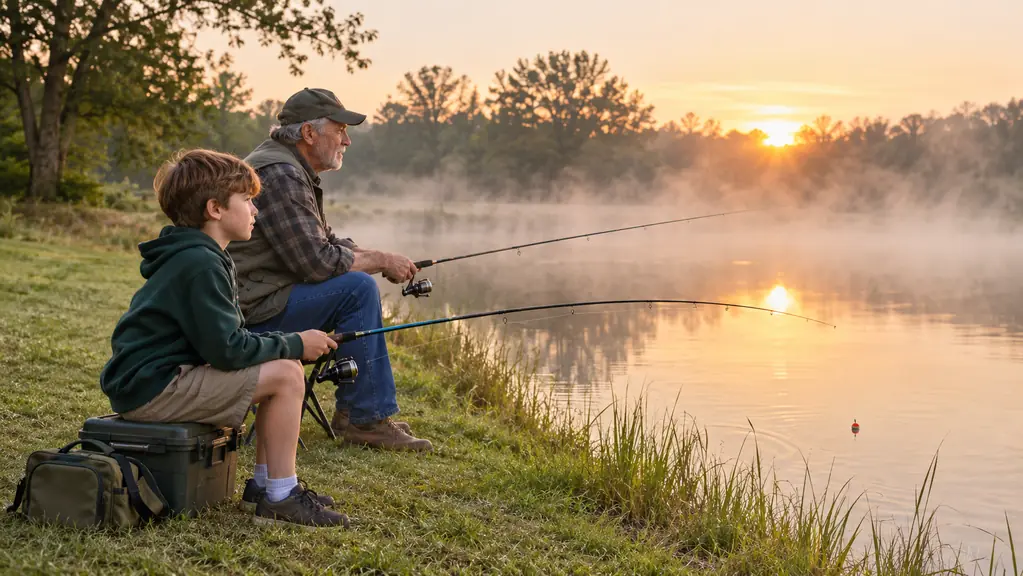
Tyler was seven the first time I handed him my spinning rod, and he had it tangled before the bait hit the water. Not a small tangle either. A real bird's nest that cost me twenty minutes on the tailgate and a foot of line I had to cut out with a pocketknife. I gave him a bobber and told him to watch for the rest of the morning. That was my mistake, not his. A ten-year-old cannot learn to cast on a reel that punishes every sloppy motion, and a spinning reel with light line punishes plenty of them.
He turned ten this past spring, and I bought him his own rod instead of letting him borrow mine. A Zebco 33 spincast combo, five foot six, two pieces, fiberglass, with a push button on the back of the reel. The button is the whole reason this works. You hold it, you swing, you let go, and the line goes where the rod pointed. There is no bail to flip, no line to trap against the cork with a finger, and nothing to backlash when his timing is off by half a second.
The rod I handed a ten-year-old, not the one I learned on
The Zebco 33 combo pairs a push-button spincast reel with a 5-foot 6-inch two-piece fiberglass rod. Ambidextrous, so it works in whichever hand he settles on, with Bite Alert that clicks when a fish pulls line. It hangs on my garage rack next to mine now.
Amazon Check Today's Price on Amazon →Before Step One: Set the Rod Up Right
Two things need to be right before anybody makes a cast, and neither one is about the reel itself.
The first is line. The 33 comes spooled with 10-pound monofilament, which is heavier than I would pick for bluegill on my own reel and exactly right for a beginner. Heavy line does not loop off the spool the way light line does, and a kid who is not fighting his own tackle learns faster. Do not top it off to the rim. Leave a little lip of spool showing, maybe an eighth of an inch, because an overfilled spincast will throw loops on the first cast and everybody blames the reel.
The second is the rod joint. This rod is two pieces, and a two-piece rod that is not seated all the way will come apart on a hard cast or twist until the guides are out of line. Push it together with a little turn, line the guides up by eye, and check it again after the first twenty casts. Tyler's came apart once, right in the middle of a cast, and the top half went about six feet out into the pond. We got it back. He checks that joint himself now, every trip, before I can ask him to.
Step 1: Put the Rod in His Hands on Dry Land
Do the first session in the driveway or the backyard with no hook, no bobber, and no water in sight. Nothing ends a first lesson faster than a hook in a thumb or a bait that flies off into the grass. Just the rod and a small weight, or honestly nothing at all.
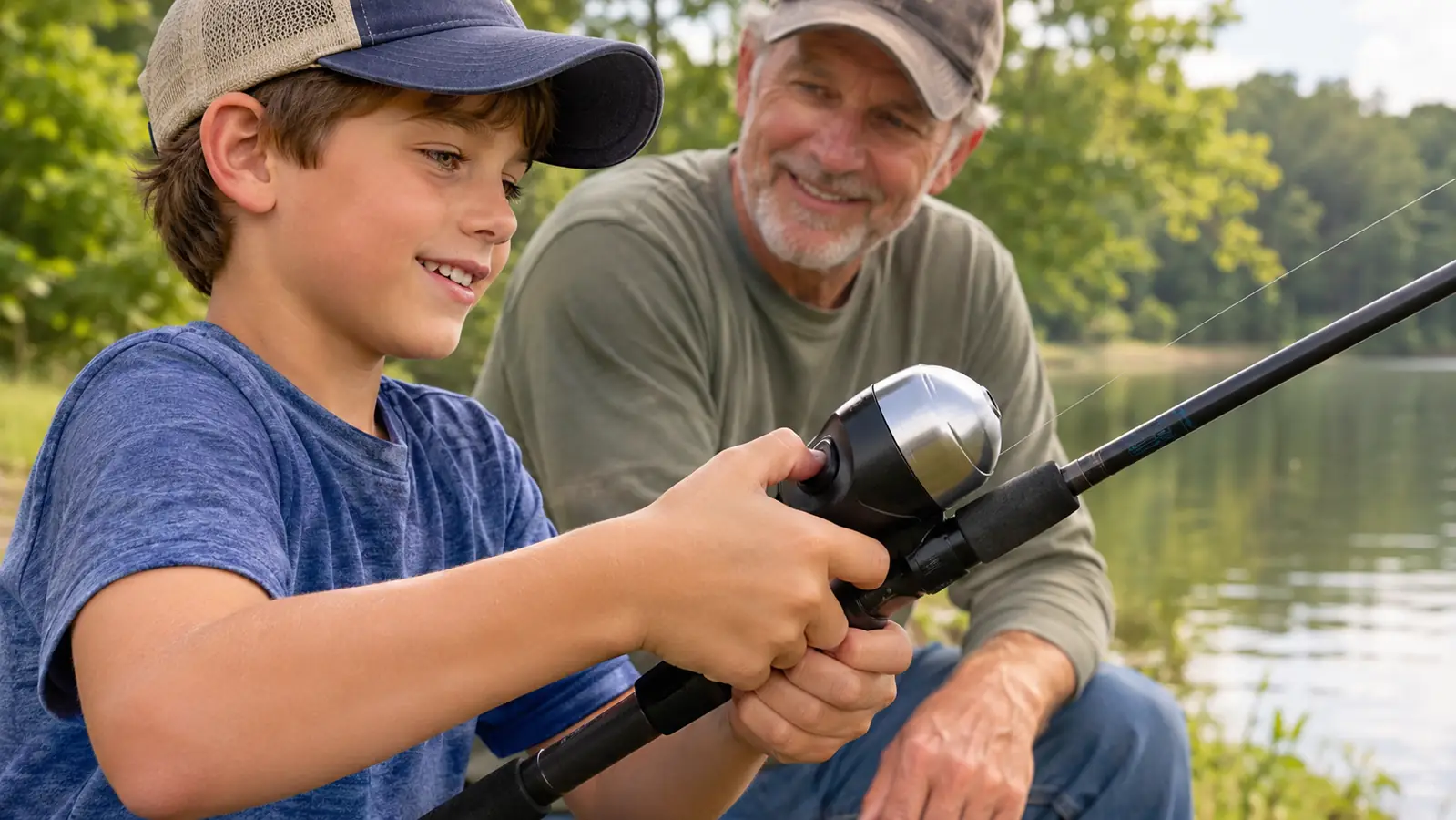
Show him where the button is, then have him hold the rod so the reel sits on top and the button sits under his thumb. The 33 is ambidextrous, which means it does not care whether he casts right or left, and you should not force a hand on him either. Tyler casts right and reels with his left. That is fine. What matters is that his thumb rests on that button without him reaching for it, because the thumb does the real work in about two minutes.
Have him press the button and hold it. Then have him press it and let go, over and over, ten or fifteen times, until the click of it is boring. Boring is what you are after. A cast is a small motion built on top of a motion he already knows cold.
Step 2: Teach the Thumb, Not the Wrist
This is the part most people skip, and it is the reason kids drop a cast into the water two feet in front of their own boots. The thumb has two jobs. It holds the button down before the cast, and it stops the spool when the bait reaches the target.
With the rod hanging at his side, have him press the button and hold it, then lift the rod tip slowly until the weight starts to slide off. The weight will drop. The moment it does, his thumb comes off the button and then goes right back on to stop the spool. Say it out loud while he does it: hold, swing, let go, stop. Four words. He will hear them in his head the rest of his life.
Twenty repetitions in the driveway with a small weight and no water. Then twenty more at the edge of the pond, landing the weight in wet grass instead of in the water. The thumb learns from repetition, and it learns fastest when there is nothing at stake.
Step 3: Make It a Pendulum, Not a Whip
Kids swing a rod like a baseball bat, because that is the only motion they know that sends something a long way. A whip on a spincast reel gives you a splash two feet out and a mess on the spool.
The cast I teach is a slow pendulum. Rod back to about ten o'clock, everything loose, then a smooth push forward to about two o'clock. Not a snap. The rod does the work, and a five-and-a-half-foot fiberglass rod loads easily at low speed, which is one more reason this combo suits a beginner. Fiberglass is forgiving. It bends instead of demanding perfect timing from a kid who does not have any yet.
Watch his elbow. If it is flying out away from his body, he is throwing instead of casting. Have him keep the elbow close and let the forearm and wrist do the small work. Then have him stop the rod at two o'clock, not down at the ground, because a rod that finishes pointing at the dirt sends the bait at the dirt.
A whip on a spincast puts a splash two feet out. A pendulum puts a bobber twenty feet out with a dry spool, and twenty feet is a real cast for a ten-year-old.
Step 4: Add Water, Then Add a Bobber
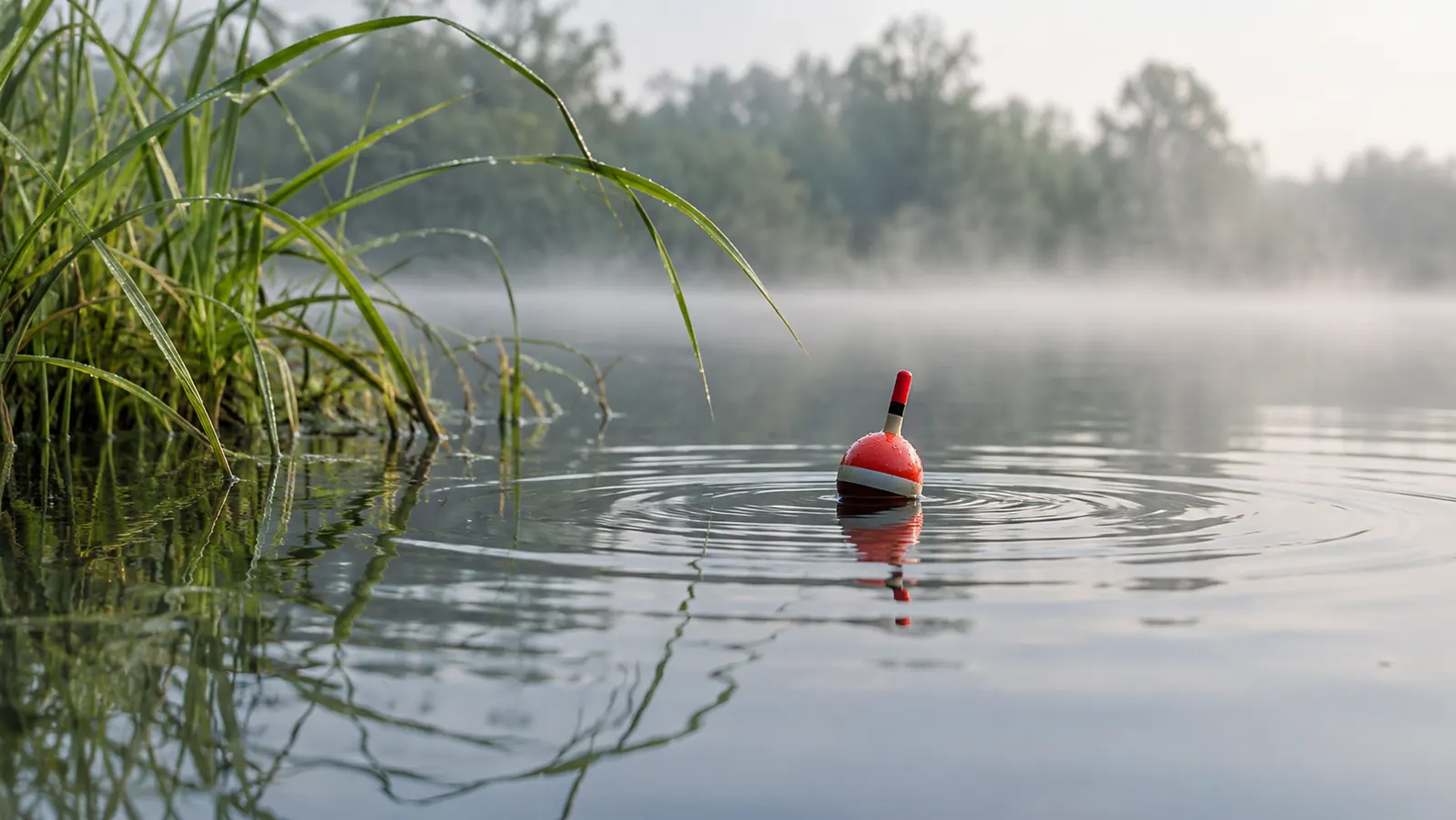
Start with short casts. Ten feet is a cast. Twenty feet is a good cast. Do not let him try for the far bank on day one, because distance comes from timing and timing comes from making the same motion a hundred times without a tangle.
A bobber and a worm is the right first rig. It floats, it is visible, and a kid can watch it. The Zebco 33 has Bite Alert, a small switch that makes the reel click when a fish pulls line off the spool, and on a pond full of bluegill that click does more for a kid's attention span than anything I could say to him. Tyler heard it, looked up, and lifted the rod before I got the words out.
Lifting the rod is the right phrase for a ten-year-old with a bobber. Not setting the hook, not jerking. The reel is geared 4.1 to 1 with all-metal gears, so a bluegill does not stress it, and the pick-up pins do the work of gathering line that his fingers would otherwise be trapping.
Step 5: Fix the Three Things That Go Wrong
Almost every bad cast in the first month is one of three things, and all three are easy to spot from behind him.
The first is letting go of the button too late. The rod has already stopped, so the bait drops straight down off the tip and lands at his feet. Cure: have him say swing out loud and release on that word, or put a bobber on and let him watch where the rod tip is at the moment the bobber leaves.
The second is his hand creeping up the handle above the reel seat, because it feels like more control. It is not, and it kills his leverage. Mark the spot with a wrap of tape if he keeps drifting. The third is line twist, which shows up as loops jumping off the spool a few casts in. Nearly always that is line put on without tension, or a bait that spins in the water. Strip twenty feet, respool it tight, and look at how the bait is rigged.
There is a fourth thing that goes wrong, but it is not a cast problem. It is you. If you take the rod out of his hands every time he misses, he learns that the rod belongs to you and the casting belongs to you. Let him miss. Hand it back and walk away ten feet.
What Else Helps
Keep the reel clean and it will outlast his interest in bluegill. Rinse it with fresh water after every trip, dry it off, and put a drop of reel oil on it once a month. That is the same routine every reel on my garage rack gets, and the Zebco has needed nothing else in the eight months Tyler has been dragging it through pond mud and leaving it in the truck.
Keep a spare spool of 10-pound monofilament in the boat bag. Not because the reel eats line, but because a kid will eventually wrap it around a dock post or step on the spool, and a five-minute respool on the tailgate beats ending the morning early. Zebco has been building this reel for a long time and parts are not hard to find, which matters more than people think when the rod belongs to a kid.
Fish where the fish are small and hungry. A neighborhood pond full of bluegill is worth more to a beginner than a lake full of big bass, because bites build the habit of paying attention. Save Lake Norman for the mornings when he asks to come along, and put him on the front deck of the jon boat with that short rod where he can cast without taking your hat off.
Last thing. Let him fish with it before you teach him anything else. Hand him the rod at the pond with a worm on it, let him drop it off the bank, and worry about the mechanics on the next trip. The casting lesson lands a lot better on a kid who already believes the rod is his.
The rod that lets a kid cast without you standing over his shoulder
Push button, 5-foot 6-inch two-piece fiberglass rod, ambidextrous reel with Bite Alert. Tyler has fished his for eight months, mostly at the neighborhood pond and on calm mornings from the jon boat. It has not needed a repair yet.
Amazon Check Today's Price on Amazon →